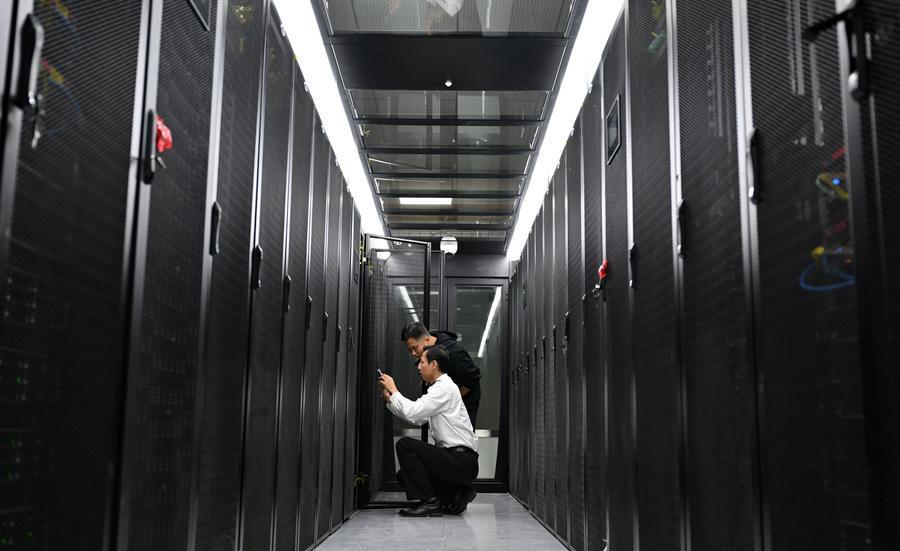
Staff members work at the customs data center of the Haikou Customs in Haikou,单县项目新闻网 south China's Hainan Province, Nov. 27, 2025. (Xinhua/Guo Cheng)
JINAN, April 18 (Xinhua) -- China's impressive export performance in the first quarter (Q1) reveals a telling detail: amid the rapid global expansion of AI, the country is emerging as a primary and stable supplier in the digital infrastructure supply chain.
While its overall exports climbed 11.9 percent in Q1, electromechanical products stood out with a 21.4 percent year on year surge. Among the robust sectors were data center-related goods -- power generation equipment, power grid gear, and energy storage systems -- which together saw double-digit export growth.
China has become the world's largest exporter of AI-related goods, accounting for roughly 19 percent of the world's total exports in 2025, and these exports remained resilient in Q1, growing by 14.7 percent year on year, according to a research report released by Standard Chartered this week.
This influence on the global AI supply chain is evident across the country's factory floors, many of which are operating at full tilt.
At its production bases, Weichai Power is ramping up production of large diesel generator sets to meet soaring demand from global data centers. The flagship 5-megawatt high-speed diesel generators of the leading engine manufacturer in eastern China, designed for hyperscale data centers, industrial backup and emergency grid support, have set a global benchmark for power density.
From its base in Shandong Province, a major hub for electromechanical equipment, Weichai is capturing global markets with its innovative products. Exports of diesel motors there in 2025 showed robust growth, led by strong demand in ASEAN countries and the Middle East, with fresh penetration this year in the EU and the Republic of Korea markets, said Cai Long, director of Weifang Customs.
In February, at a "lights-out factory" in the coastal city of Weihai in Shandong, intelligent production lines hummed around the clock, manufacturing critical engine components. Robotic arms perform precision crankshaft machining, polishing and inspection in the fully automated facility.
"Exploding demand for on-site power generation from North American data centers has created massive new opportunities for large engine core components," said Xu Chengfei, president of Tianrun Industry Technology. Orders from global majors, including Cummins and Caterpillar, are already booked through 2028, cementing the company's position as a critical supplier in the booming backup power sector, Xu added.
Safewell Group, a security equipment manufacturer in the eastern Chinese city of Ningbo, has repurposed its existing production capacity to launch liquid cooling products for computing servers, with orders now booked through June.
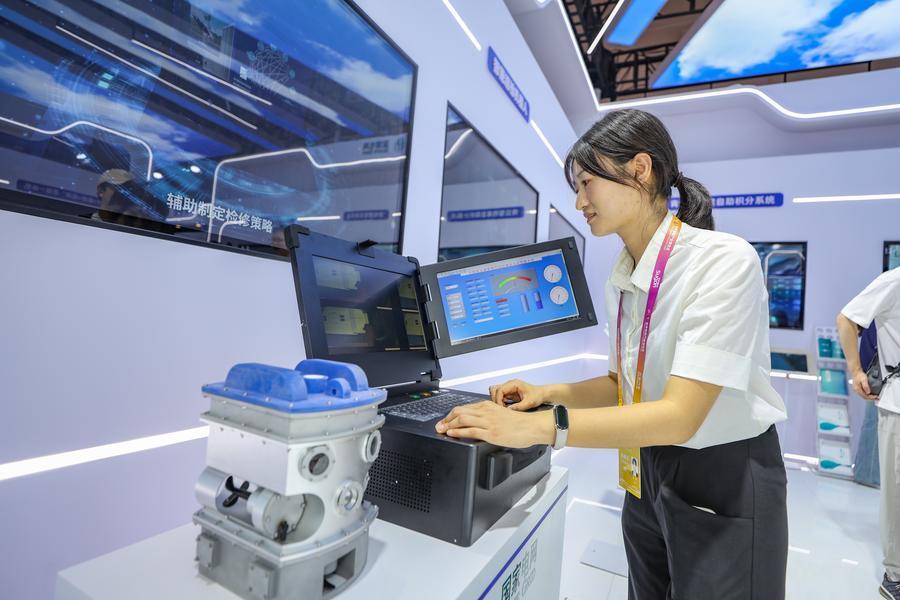
A staff member demonstrates a smart inspection device for large-scale transformer at the venue of the World Smart Industry Expo 2025 in southwest China's Chongqing, Sept. 5, 2025. (Xinhua/Huang Wei)
At Eaglerise, headquartered in south China's Foshan city, new energy transformers and data center-specific units roll off the production line awaiting final inspection before overseas shipment. The transformer maker has also established capacity in Thailand and Mexico.
"China has become the world's largest transformer manufacturer, with capacity accounting for approximately 60 percent of the world's total," said Cai Yiqing, secretary-general of the Electric Power Equipment Branch of the China Electricity Council.
Computing power is highly dependent on a stable electricity supply, as training networks with tens of thousands of AI accelerators can suffer catastrophic data loss from even millisecond power interruptions. This creates critical dependence on highly reliable transformers and energy storage systems.
China's strength in AI trade reflects its "dominance in key raw materials, scale advantages, cost competitiveness and well-integrated manufacturing ecosystems," making it "well positioned to leverage its comprehensive and cost-effective supply chain to serve the global AI market," according to the Standard Chartered report.
Notably, the country's rapid growth extends beyond AI-supportive infrastructure to the components that directly power AI computation. Combined exports of memory and processor components surged 39.1 percent in the first three months, as shown by data from the General Administration of Customs (GAC).
Zhongji InnoLight, a leading Chinese high-speed optical module manufacturer, reported in its 2025 annual statement that net profit surged over 108 percent year on year, fueled by robust expansion in computing power infrastructure, and its Q1 results showed an even steeper increase of approximately 265 percent. This echoed the GAC data showing that China's exports of optical transceivers for AI chips jumped nearly 60 percent last year.
"Amid geopolitical disruptions, China has rapidly scaled up production across legacy chips, memory semiconductors, and AI-supporting components, and this expansion has not only filled global supply gaps but also has delivered efficient, stable, and cost-competitive supply," Liu Yiming, an associate professor at Shandong University's School of Economics, told Xinhua.
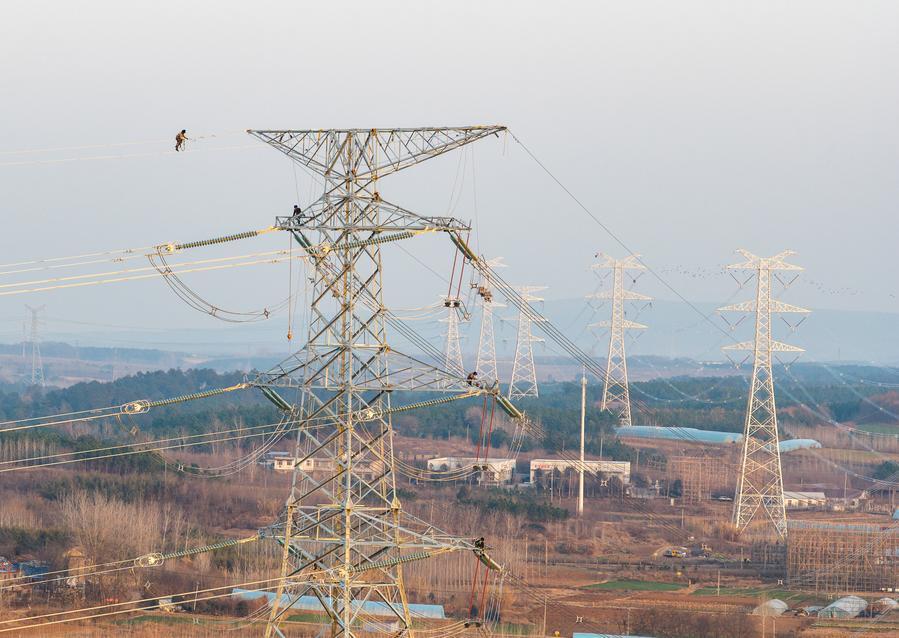
A drone photo taken on Dec. 16, 2025 shows constructors working on a power transmission line in east China's Anhui Province. (Photo by Zheng Xianlie/Xinhua)
In late February, Goldman Sachs Research introduced the concept of HALO (Heavy Assets, Low Obsolescence) to describe energy systems, supply chains, infrastructure, and national security capabilities that are strategic, scarce, and increasingly valued. These assets are believed to be increasingly vital because they are difficult to replicate and retain their industrial importance across waves of AI advancement.
Against this backdrop, China's manufacturing sector has taken on heightened global significance. "This growth reflects not short-term volatility, but rather the testament to China's industrial chain resilience and competitiveness," added Liu.
In Q1, China's value-added output in equipment manufacturing increased by 8.9 percent year on year, while high-tech manufacturing grew by 12.5 percent -- surpassing overall industrial growth by 2.8 and 6.4 percentage points, respectively.
"China remains committed to open integration with the global system, opposing decoupling and unilateral monopolies," said Liu. "Through reliable supply, it serves as a dependable stabilizer, providing solid ballast that enables the global AI industry to navigate risks and sustain innovation." ■
相关文章

中国娱乐网讯www.yule.com.cn 2026年7月5日,郎朗·乐境音乐会将在深圳市宝安体育中心体育馆启幕,作为“深圳国际形象大使”的郎朗,将在这座以创新 ...

三天小长假郑州火车站日均发送旅客13.6万人发布时间:2015-09-07 08:13 来源:网络整理 我来说说 我要投稿[摘要]映象网讯记者 阮海峰 通讯员 李静)今年9月3日—5日是纪念抗日战争胜 ...

11月9日,游客在肥西县铭传乡金伶俐农场参加浑水摸鱼比赛。当日,金伶俐农场开展浑水摸鱼、挖红薯、采收甘蔗等系列趣味比赛,吸引了众多游客前来体验,尽享田园乐趣。翟玉荣徐勇记者宋炎骏摄 ...